
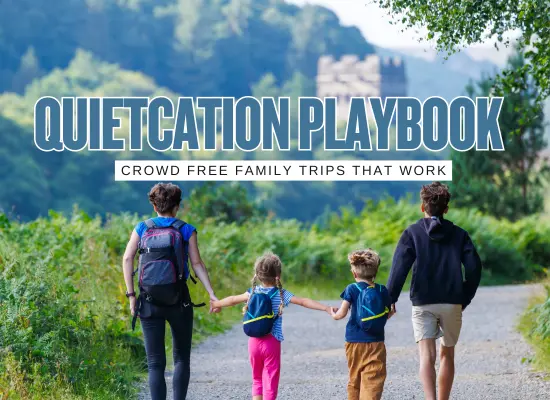
The best family “quietcation” is not a boring trip. It is a trip where the fun is still there, but the friction is gone: no shoulder-to-shoulder sidewalks, no hour-long waits for basic food, no parking-lot gridlock, no feeling like you are paying money to stand in a line. This playbook shows how families actually pull that off.
Crowd free trips that still feel fun
This is not about hiding from people. It is about choosing timing, bases, and daily rhythms that remove the biggest pain points: parking, lines, meal chaos, and overstimulation.
The quietcation definition kids actually understand
Quietcation = less waiting, more doing. You still do fun stuff. You just do it in a way that keeps your family regulated: shorter lines, calmer spaces, and fewer “everyone is hungry at once” moments.
12 quietcation moves that work almost anywhere
The destination filters that consistently produce quieter family trips
These are not “secret places.” These are patterns that make crowd pressure less likely.
🧭 Filter A: Two hubs instead of one hotspot
How it works: Choose a calm base near the “kid fun” and a second base near the “nature wow.” You cut long day trips and reduce the worst crowd times.
- Family positive result: each day becomes shorter and easier.
- Best for: islands, big states, national-park regions, and lake areas.
🏖️ Filter B: Beach towns with multiple beach access points
How it works: The crowd concentrates at one main entrance. Towns with many access points let you pick your calm zone.
- Family positive result: you get “beach day fun” without parking chaos.
- Best for: families with kids who need space to play.
🌲 Filter C: Nature that still has bathrooms, picnic tables, and short trails
How it works: Choose destinations where the “wow” is accessible. Overlooks, boardwalks, short loops.
- Family positive result: you can do nature daily without exhaustion.
- Best for: mixed ages and stroller stages.
🏨 Filter D: Lodging with entertainment built in
How it works: Pool, playground, trails, rec room, beach access, or a walkable loop. It gives you a default plan that requires zero lines.
- Family positive result: the trip stays fun even if you skip crowded attractions.
- Best for: long weekends and spring break weeks.
Quietcation day rhythm that works for most families
- Morning: one popular thing early, then leave before peak.
- Midday: early lunch plus a calm reset.
- Afternoon: low-line fun (pool, beach, park, short nature loop).
- Evening: one simple ritual (sunset, dessert, walk).
Quietcation Score (will this trip feel calm or crowded?)
Quick estimator based on timing, bases, and how many “peak” moments you are stacking.
Tap Calculate
You will get a score and a tweak.
Plan A / Plan B Builder (weather and crowds)
Build a calm fallback so you are never forced into the loudest option.
Tap Generate
A quietcation is basically a fun trip that stays regulated: fewer lines, more space, and a daily rhythm that prevents the “everyone is done” crash. When you plan the crowd pattern first, the destination usually gets easier.

